Vaccine Storage Units
Providers participating in any of California’s vaccine programs agree to store vaccines in refrigerators and freezers that meet program requirements and replace equipment that no longer complies. Proper storage units protect patients from inadvertently receiving compromised vaccine and protect providers from costs of revaccinating patients, replacing expensive vaccines, and loss of patient confidence.
Benefits
Providers might maintain an average vaccine inventory ranging from tens of thousands to more than $500,000 over the course of a year. Reliable storage units help protect your facility from the costs of revaccination, replacement of expensive vaccines and loss of patient confidence due to compromised vaccines.
Purchasing Considerations
Providers must purchase a new vaccine refrigerator or freezer if vaccine storage units do not meet program requirements or the practice has had storage incidents resulting in spoiled vaccines. Storage units must have sufficient capacity to accommodate vaccine stock at the busiest time of year without overcrowding.
Refrigerators and freezers are available in different types and grades. Not all are designed to maintain proper temperatures that protect vaccine viability.
Types
- Stand-alone: Self-contained units designed as refrigerator-only or freezer-only; range in size from compact, under-the-counter styles to large pharmaceutical-grade units
- Combination: Have both a refrigerator and a freezer with separate exterior doors
Grades
- Pharmaceutical: Purpose-built grades designed to maintain consistent temperatures for vaccines or biologics in pharmacy, biologics, or laboratory settings
- Commercial: Intended to store food and beverages in commercial settings; are often larger and more powerful than household units but are not designed to store biologics and experience some temperature fluctuations
- Household: Intended for food storage in homes and offices
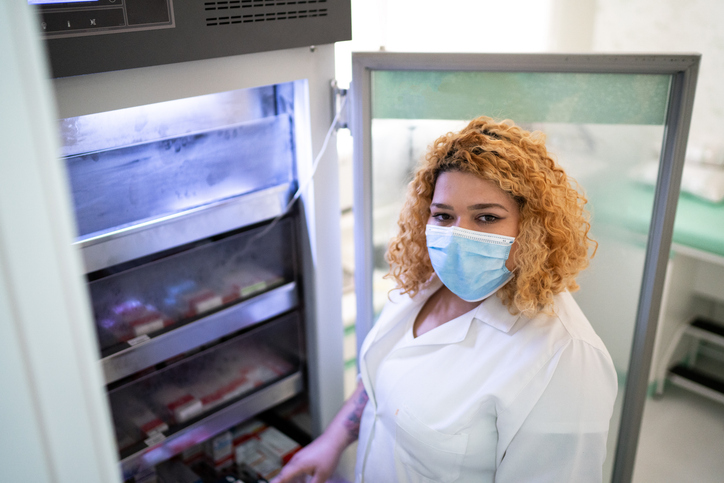
Vaccine Storage Units
Click to explore these topics:
Refrigerators
- Maintains consistent temperatures between 36.0ºF and 46.0ºF (2.0ºC and 8.0ºC)
- Compact units with 11 cu ft capacity or less must be pharmacy- or biologic-grade
- Stores all refrigerated vaccines + enough water bottles to stabilize temperatures
- Defrosts automatically
- Seals tightly and close properly
- Used primarily for vaccine storage (if necessary, medications or biologics not inoculated may be stored below vaccines)
Acceptable Refrigerators
When evaluating existing or shopping for new vaccine refrigerators, select the required grade and type by practice volume.
| Grade (Type) Rating | Description | Practice Volume |
| Pharmacy- or biologic-grade Best | Purposely built to maintain consistent temperatures for storage of vaccines or biologics. Come in stand-alone and combination units. | Very high (required) Others: Preferred |
| Compact pharmacy- or biologic-grade (stand-alone) Best | These under-the-counter units are suitable for smaller practices with limited space. | Low, Medium, High |
| Commercial units* (stand-alone) Good | Intended to store food and beverages in commercial settings. Are often larger and more powerful than household units but not designed to store biologics and experience some temperature fluctuations. | Low, Medium, High |
| Household* (stand-alone) Discouraged | Intended for use in homes and offices, typically for food storage. Like commercial units, are not designed to store biologics and experience frequent temperature fluctuations. | Low, Medium, High |
Freezers
- Maintains consistent temperatures between -58.0°F and 5.0ºF (-50.0°C and -15.0ºC)
- Must use stand-alone units, or pharmacy- or biologic-grade combination units
- Stores all frozen vaccines + enough cold packs to stabilize temperatures
- Defrosts automatically (or manual with access to VFC-compliant freezer and data logger; temporary vaccine storage in coolers is unacceptable)
- Seals tightly and close properly
- Used only for vaccine storage
Acceptable Freezers
When evaluating existing or shopping for new vaccine freezers, select the required grade and type by practice volume.
| Grade (Type) Rating | Description | Practice Volume |
| Pharmacy- or biologic-grade (stand-alone) Good | Specifically designed to maintain consistent temperatures for storage of vaccines or biologics. | Any practice |
| Pharmacy- or biologic-grade (combination) Good | Have more than one compressor allowing for better and separate temperature control of the refrigerator and freezer compartments. | Any practice |
| Commercial units* (stand-alone) Good | Intended to store food and beverages in commercial settings. Are often larger and more powerful than household units but not designed to store biologics and experience some temperature fluctuations. | Any practice |
| Household* (stand-alone) Good | Intended for use in homes and offices, typically for food storage. Like commercial units, are not designed to store biologics and experience frequent temperature fluctuations. | Any practice |
*These units may require additional frozen cold packs to maintain stable temperatures. Contact your Field Representative for guidance.
Placement Considerations
Make sure storage units fit in a designated space
- with good air circulation,
- away from direct sunlight and any heat sources,
- within reach of an outlet (without an extension cord) that is not shared with other appliances or controlled by wall switch, and
- with at least 4 inches of space around top, bottom and sides.
If you are unclear about vaccine storage unit requirements, contact your Field Representative prior to making a purchase.
Types & Grades
Refrigerators and freezers are available in different types (stand-alone and combination) and grades (pharmaceutical, commercial and household). Not all are designed to maintain proper temperatures that protect vaccine viability.
Stand-alone: Self-contained units designed as refrigerator-only or freezer-only; range from compact, under-the-counter styles to large pharmaceutical-grade units.
Combination: Have both a refrigerator and a freezer with separate exterior doors.
Pharmaceutical: Purpose-built grades designed to maintain consistent temperatures for vaccines or biologics in pharmacy, biologics or laboratory settings.
Commercial: These grades (intended to store food and beverages in commercial settings) are often larger and more powerful than household units but are not designed to store biologics and experience some temperature fluctuations.
Household: These grades are intended for food storage in homes and offices.
Unacceptable Storage Units
| Type | Comments |
| Compact household refrigerator (stand-alone) | Small, under-the-counter stand-alone refrigerators with a capacity 11 cubic feet or less. |
| Household combination refrigerator/freezer | Have one compressor with poor temperature control. May pose a risk to refrigerated vaccines because cold air from freezer is vented into refrigerator and can freeze vaccines. Freezer portions of many combination units are not capable of maintaining consistent temperatures for frozen vaccines. |
| Dormitory-style and bar-style combined refrigerator/freezers | Have a single exterior door and evaporator plate/cooling coil, usually located in an icemaker/freezer compartment. Pose a significant risk of freezing—even when used for temporary storage. |
| Manual defrost refrigerators | Have an exposed vertical cooling (chilling) plate at back of refrigerator, which poses potential risk of significant temperature variation and freezing vaccines. |
| Convertible units | Have internal switch that converts “all-refrigerator” unit to “all-freezer” unit. |
| Cryogenic freezers | Reach temperatures well below -58.0°F (-50.0°C), too cold for frozen vaccines. |
Ready to Buy?
Providers may purchase any vaccine storage unit that meet program requirements. CDPH does not endorse or recommend specific storage units. If unclear about vaccine storage unit requirements, contact your Field Representative prior to making a purchase.
Placement Considerations
Before purchasing, ensure storage units will fit in a space that meets program requirements and best practices.
- Locate vaccine storage units away from public spaces, direct sunlight, and heat sources.
- Plug each storage unit into its own wall outlet to ensure all vaccines aren’t at risk if a breaker is tripped. Alternately, document in the provider’s vaccine management plan how staff are to respond should power to multiple storage units be lost.
- Do not use outlets controlled by wall switches or outlets with built-in circuit breakers because power can easily be interrupted.
- Position storage units to allow good air circulation around top, sides, and back.
- Consider an on-site generator, which can prevent vaccine transport to an alternative facility. Keep sufficient fuel on hand to run the generator for at least 72 hours
Configuring Storage Units
Storage units must be prepared to maintain stable temperatures before storing vaccines. Careful grouping of vaccines and labeling of baskets or shelf space reduces administration errors and vaccine exposure to room temperatures while staff are searching for vaccine products. Follow this guidance to comply with program requirements.